
Marco Florez: Azure platforms that keep AI agents governed
For platform, cloud and DevOps engineers: how I set up Azure and GitHub for AI agents, from a Solutions Architect with 13 Microsoft and GitHub certifications.
I'm Marco Florez, a Solutions Architect in Switzerland. I design Azure platforms for a living: landing zones, policy baselines, and the Bicep modules and pipelines that deploy them. In my own time I build automations and AI integrations that save me real hours, mostly with AI coding tools like Claude Code, then GitHub Actions and n8n. My focus now is AI agents on Azure and GitHub that work under the same controls as a colleague with commit rights. What I learn along the way ends up here.
Use cases, posts and third-brain notes
The site has three parts.
Use cases. Set-ups with every step and the code, each with the date I last checked the steps.
Posts. Longer write-ups on infrastructure as code, pipelines, n8n workflows and AI in day-to-day operations.
Third-brain notes. My first brain is in my head, my second is my private Obsidian vault. The third is the public part: short, opinionated notes on the tools and practices I use, trial, watch or have dropped, each reviewed at least every 60 days. Explore it.
These are personal notes and views, not those of my employer, and there is no client or confidential information on this site.
13 Microsoft and GitHub certifications
Certifications · all current
Expert
- Azure Solutions Architect Expert
- DevOps Engineer Expert
- Cybersecurity Architect Expert
Associate and Specialty
- Azure Administrator Associate
- Azure Developer Associate
- Azure Network Engineer Associate
- Azure Security Engineer Associate
- Cloud and AI Security Engineer Associate
- Azure Virtual Desktop Specialty
GitHub
- GitHub Certified: Agentic AI Developer
- GitHub Copilot
- GitHub Actions
AI strategy
- AI Transformation Leader
Nothing reaches this site without me
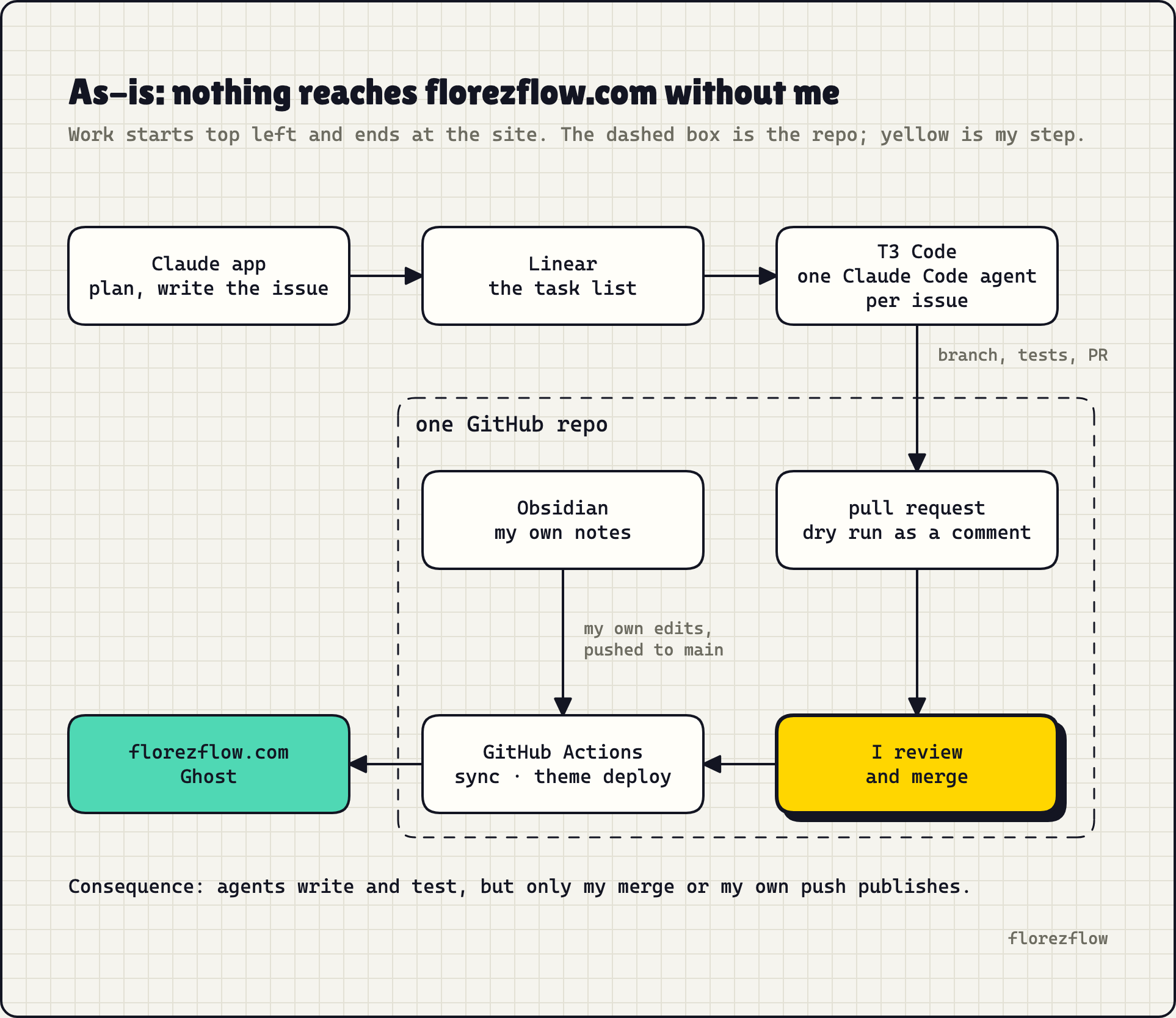
Everything behind this site lives in one GitHub repo: the Obsidian vault with the notes, the Ghost theme and the publisher that connects them.
- Plan. I think an idea through in the Claude app and turn it into a Linear issue.
- Build. From my phone I start a T3 Code thread on my Mac mini: one Claude Code agent per issue, in its own copy of the repo. It works on a branch, runs the tests and opens a pull request.
- Check. Every pull request gets a dry run of the publisher as a comment: what would be created, changed or taken offline, and whether an email would go out.
- Publish. I review and merge. GitHub Actions then syncs the notes to Ghost and deploys the theme. Notes I write myself in Obsidian take the same path when I push them.
The agents write and test. Only my merge, or my own push, changes what you read here.
Four things I help teams get right
- AI coding agents on GitHub that can't merge without you: a required plan, a read-only token, a human approval gate, allowlisted MCP tools and hooks that say no.
- Shared Bicep modules with one version each, pulled from a private registry and checked by a version gate, PSRule and what-if on every pull request.
- Azure landing zones that start from the reference architecture and a policy baseline, trimmed to what your team can operate.
- An AI rollout for an IT team that ends in a decision: which tools may see which data, and four numbers that show whether it pays.
What I don't do:
- Legal advice. My notes on the EU AI Act and Swiss AI rules are research. For a binding assessment, ask a lawyer.
- Other clouds. I work on Azure and GitHub.
New posts and third-brain notes by email when I publish them, nothing else.
Get new posts by email