
Research on EU AI Act and Swiss Regulatory Stance
Research on EU AI Act and Swiss Regulatory Stance
DISCLAIMER: The information provided in this document is based on personal research and is intended for informational purposes only. The author is not a lawyer, and this content does not constitute legal advice. No guarantee is given regarding the completeness, correctness, or currentness of the information. For specific legal advice and binding compliance assessments, please consult a qualified legal professional or the relevant supervisory authorities.
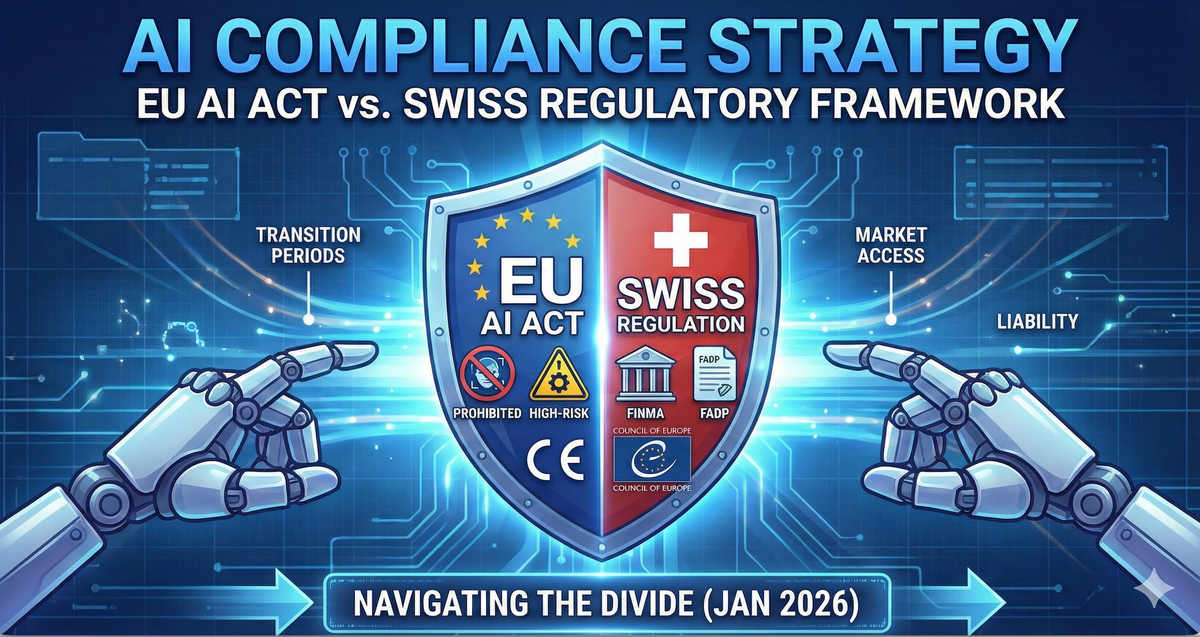
AI Compliance Strategy: EU AI Act vs. Swiss Regulatory Framework (Jan 2026)
Date: January 21, 2026
Target Audience: Developers, Cloud Architects, AI Transformation Leaders, and Compliance Officers operating in the DACH region.
1. Executive Summary
Why it matters: For strategic leaders, this section provides the "elevator pitch" on the current regulatory reality—moving from theory to active enforcement risks—essential for briefing the C-suite today.
As of January 2026, the European regulatory landscape for Artificial Intelligence has transitioned from theoretical frameworks to active enforcement. The European Union's AI Act is partially in force, with critical prohibitions effective since February 2025 and General Purpose AI (GPAI) governance rules active since August 2025.
Switzerland, conversely, has opted against an immediate horizontal "Swiss AI Act." It is pursuing a strategy aligned with the Council of Europe's Framework Convention and existing sector-specific regulations (notably FINMA guidance for the financial sector), while preparing draft federal legislation expected by late 2026.
This document outlines the current compliance obligations for technical and strategic leaders operating in Germany (EU) versus Switzerland, with a specific focus on the extraterritorial implications for Swiss enterprises.
2. The EU AI Act: Implementation Status (January 2026)
Why it matters: Compliance is no longer a future problem. Specific bans and training mandates are legally binding right now. Ignoring these dates exposes your organization to immediate penalties and operational shutdowns.
The EU AI Act (Regulation 2024/1689) functions as a product safety regulation, classifying AI systems based on risk severity. For entities operating within the EU single market, transitional grace periods are concluding.
Effectively Enforced Provisions (Today)
- Prohibited AI Practices (Effective Feb 2, 2025): "Unacceptable Risk" systems are illegal. This includes AI for social scoring, biometric categorization (e.g., inferring race, political opinions), and emotion recognition in workplace or educational settings.
- AI Literacy Mandate (Effective Feb 2, 2025): Article 4 mandates that providers and deployers ensure their staff possesses sufficient AI literacy. This is a legal requirement, necessitating documented training and competence verification for development and operations teams.
- General Purpose AI (GPAI) Governance (Effective Aug 2, 2025): Providers of GPAI models (e.g., GPT-4, Claude, Gemini) must adhere to transparency obligations, copyright compliance, and detailed training data summaries. Models classified as posing "systemic risk" face rigorous adversarial testing and incident reporting requirements.
Upcoming Critical Deadlines
- August 2, 2026 (High-Risk Systems): This is the definitive compliance deadline for the majority of enterprise AI applications. Systems deployed in HR (recruitment), Critical Infrastructure, Credit Scoring, or Education must undergo a formal Conformity Assessment, bear a CE marking, and be registered in the EU database.
- Post-Market Monitoring (Effective Feb 2, 2026): By next month, regulations regarding the continuous monitoring of deployed AI systems will be enforced.
Strategic Imperative: If you utilize "Prohibited" AI, you are in immediate violation. If you are architecting "High-Risk" AI, you have fewer than 7 months to finalize technical documentation and implement a Quality Management System (QMS).
3. The Risk Classification Framework
Why it matters: Your architectural decisions today define your regulatory burden tomorrow. Classifying your system correctly (Prohibited vs. High-Risk vs. Limited) dictates whether you need a full Quality Management System or just a simple disclaimer.
The EU AI Act adopts a risk-based architectural compliance model. Regulatory burden scales directly with risk classification. Use the EU AI Act Explorer for preliminary classification.
Also see AI-ACT Definitions - Article 3
1. Unacceptable Risk (Prohibited) - Article 5
These systems threaten fundamental rights and are banned. See Article 5 for the legal text.
- Social Scoring: Algorithmic evaluation of social behavior.
- Emotion Recognition: Inferring emotional states in professional or educational environments.
- Subliminal Manipulation: Techniques deploying dark patterns to distort behavior.
- Biometric Categorization: Remote inference of sensitive attributes.
2. High-Risk AI Systems - Annex III
Permitted but subject to rigorous compliance obligations. The full list is detailed in Annex III.
- Critical Infrastructure: Safety components in utilities (water, gas, electricity).
- Employment: Algorithms for recruitment screening, task allocation, or performance evaluation.
- Essential Services: Credit scoring and benefits eligibility assessment.
- Law Enforcement: Predictive policing and evidence reliability tools.
3. Limited Risk - Article 50
Systems presenting specific transparency risks. Users must be informed of AI interaction. Refer to Article 50.
- Conversational AI: Chatbots must disclose identity ("I am an AI").
- Synthetic Content: Deepfakes must be machine-readable and clearly watermarked/labeled.
- GPAI: Models must adhere to copyright and transparency rules.
4. Minimal Risk
The majority of AI systems fall into this category and remain unregulated by the AI Act (GDPR obligations persist).
- Examples: Spam filters, AI-driven inventory optimization, video games.
4. Roles & Responsibilities: Provider vs. Deployer
Why it matters: This is the most dangerous trap for devs and SMEs. Accidentally becoming a "Provider" (e.g., by white-labeling a tool) shifts liability from "read the manual" to "million-euro compliance audit."
Correctly identifying your legal role is paramount. Misclassification can lead to significant liability. Refer to the Small Business Guide to the AI Act for detailed guidance.
👤 The Provider (Anbieter)
You are a Provider if you develop an AI system (or commission one) and place it on the market under your own name or trademark.
- Example: OpenAI (GPT-4), or an ISV selling a proprietary HR analytics platform.
- Obligations (High-Risk):
- Implement a comprehensive Quality & Risk Management System (Art. 9).
- Ensure data governance (training/validation/testing splits) to mitigate bias (Art. 10).
- Maintain exhaustive technical documentation and automated logging (Art. 11-12).
- Complete Conformity Assessment, register in the EU Database, and affix CE marking.
👤 The Deployer (Betreiber)
You are a Deployer if you utilize an AI system under your authority in a professional context.
- Example: An enterprise integrating ChatGPT for internal knowledge management or using a vendor's credit scoring API.
- Obligations:
- Adherence to Instructions: Operate the system strictly according to the Provider's instructions of use.
- Human Oversight: Implement technical and organizational measures for human oversight (Art. 14).
- Data Governance: Ensure input data is relevant, representative, and accurate.
- Transparency: Notify employees and customers of AI interaction.
👤 Additional Roles
- Authorized Representative (Bevollmächtigter): An EU-based representative acting on behalf of a non-EU provider. They are legally responsible for ensuring the provider's compliance with the AI Act (often legal firms or EU subsidiaries).
- Importer (Importeur): Any entity that introduces an AI system from a third country (e.g., USA, Switzerland) into the EU market. If you procure a tool directly from abroad and distribute it within the EU, you assume this role and its verification duties.
- Product Manufacturer / Downstream Provider (Produkthersteller): A frequent role for automators. If you take a third-party AI system (like an LLM), customize it, or integrate it into a new product/service and market it under your own name, you are legally treated as the Provider.
⚠️ The Greatest Danger: Role Switching (Provider Transformation)
This is the critical point where many Freelancers and SMEs unconsciously become a Provider.
If you substantially modify an existing system (e.g., GPT-4) or distribute it to clients under your own name or branding, you are legally upgraded from "Deployer" to "Provider."
Consequence: You suddenly inherit the full burden of technical documentation, conformity assessments, and certification.
For further analysis, consult the IHK München Guide.
Architectural Note: If you engineer an automation workflow (e.g., n8n + OpenAI) for a client, contractually define the "Provider." If you deliver it as your proprietary solution, you assume Provider liability.
5. The Swiss Regulatory Approach
Why it matters: Silence does not mean safety. While there is no single "Swiss AI Act" yet, sector-specific rules (FINMA) and fundamental rights (Council of Europe) create a complex, fragmented compliance landscape you must navigate today.
Switzerland diverges from the EU's horizontal legislation, favoring a vertical, sector-specific, and principle-based framework.
Current Framework
- Council of Europe Framework Convention: Signed by Switzerland in March 2025. It establishes binding principles regarding human rights, democracy, and rule of law in AI, without the prescriptive technical standards of the EU AI Act. Details at admin.ch.
- Sector-Specific Regulation (FINMA): For the financial sector, FINMA Guidance 08/2024 (Dec 2024) mandates rigorous governance, risk management, and data quality controls. It clarifies that existing supervisory law applies fully to AI technologies. See finma.ch.
- Federal Data Protection Act (FADP/DSG): Revised Sept 2023, the FADP is technology-neutral and directly applicable to AI. It enforces transparency for automated individual decisions and strict privacy standards. Guidelines via FDPIC (EDÖB).
Legislative Outlook
The Federal Council has mandated the FDJP to draft a legislative proposal by end of 2026. This legislation aims to close specific regulatory gaps rather than duplicate the EU AI Act, likely focusing on:
- Transparency obligations.
- Legal redress mechanisms.
- International interoperability to ensure market access for Swiss AI exports.
6. Comparative Analysis: EU vs. Switzerland
Why it matters: A cheat sheet for Architects operating across borders. Understand at a glance where the regimes align (principles) and where they diverge (prescriptive CE marking vs. risk management), so you can design one system that satisfies both.
| Feature | EU AI Act | Swiss Approach (Current) |
|---|---|---|
| Architecture | Horizontal Regulation (Single comprehensive law) | Sector-Specific + Existing Statutes (FADP) |
| Nature | Product Safety Regulation (CE Marking) | Principle-based & Risk Management |
| Prohibitions | Statutory ban list (Art. 5) | No statutory bans (regulated via Fundamental Rights/FADP) |
| Enforcement | National Competent Authorities & AI Office | Existing bodies (FDPIC/EDÖB, FINMA) |
| High-Risk Req. | Prescriptive (QMS, Logging, Accuracy metrics) | Risk-based due diligence (Governance) |
7. Extraterritorial Implications
Why it matters: Geography is not a shield. If your code runs in the EU or processes EU citizens' data, EU law applies. Misunderstanding this "long arm" jurisdiction is the single most common legal failure for Swiss tech companies.
A critical misconception among Swiss enterprises is the belief that the EU AI Act is irrelevant to non-EU jurisdictions. This is architecturally and legally incorrect.
The EU AI Act applies extraterritorially to any provider placing an AI system on the EU market or putting it into service in the EU.
- Scenario A: A Swiss ISV sells an AI-driven HR tool to a German client. Result: The Swiss ISV must fully comply with the EU AI Act as a Provider.
- Scenario B: A Swiss bank operates an AI system that processes the data of EU citizens and produces legal effects within the EU. Result: The Act is likely applicable.
The "Downstream Provider" Risk
Developers utilizing APIs (e.g., OpenAI) to build custom solutions often inadvertently assume "Provider" status under the EU AI Act if they:
- Brand the AI system as their own.
- Modify the model parameters or context substantially.
In these scenarios, the Swiss developer inherits the comprehensive compliance burden (documentation, QMS) of a Provider.
8. Strategic Recommendations
Why it matters: Theory is fine, but execution is better. This is your immediate "Go-Do" list to secure your organization, audit your risks, and prepare for the 2026 deadlines before the regulators come knocking.
For EU-Based Entities (Germany)
- Immediate Audit: Verify the absence of any Prohibited AI practices (e.g., biometric categorization).
- Literacy Verification: Document AI training programs to satisfy Article 4 mandates.
- High-Risk Preparation: Initiate Conformity Assessments for High-Risk systems immediately. The Annex IV documentation requirements are extensive and require significant lead time.
For Swiss-Based Entities
- Dual Compliance Strategy: If exporting to the EU, architect for EU AI Act compliance and Swiss FADP adherence. Treat the EU Act as the "High Water Mark" for product engineering standards.
- FINMA Audit: Financial institutions must audit AI governance frameworks against Guidance 08/2024 immediately.
- Transparency Defaults: Implement explicit labeling for all AI interactions (chatbots, generated content). This ensures compliance with the EU AI Act and aligns with Swiss FADP transparency principles.
9. Compliance Checklist: Getting Started
Why it matters: This is your operational roadmap. Use this 6-point checklist to benchmark your current AI maturity and ensure no critical compliance gap is left unaddressed.
- [ ] Inventory AI Systems: Create a comprehensive overview of all AI systems currently utilized in your organization, including their specific deployment contexts and business purposes.
- [ ] Conduct Risk Assessments: Evaluate every inventoried system against the AI Act’s risk categories (Unacceptable, High, Limited, Minimal) to determine your specific legal obligations.
- [ ] Define Clear Responsibilities: Explicitly assign ownership for the operation, continuous monitoring, and regulatory compliance of each AI system.
- [ ] Build AI Competence: Implement training programs to ensure all relevant staff possess the technical and ethical skills required for professional AI usage (Mandatory since Feb 2, 2025).
- [ ] Verify Transparency Obligations: Audit and implement the necessary disclosure requirements (e.g., "I am an AI" labels or synthetic content watermarking) for all applicable systems.
- [ ] Continuous Monitoring & Review: Establish regular audit cycles to review AI system performance and stay updated on the rapidly evolving regulatory landscape.
10. References & Official Sources
Why it matters: Don't rely on summaries alone. These are the primary sources—the actual laws, official guides, and interactive tools—that you need to bookmark for definitive answers during your compliance journey.
- EU AI Act (Official Text): https://artificialintelligenceact.eu/
- EU AI Act Explorer (Interactive Tool): https://artificialintelligenceact.eu/ai-act-explorer/
- Small Businesses Guide to the AI Act: https://artificialintelligenceact.eu/small-businesses-guide-to-the-ai-act/
- IHK München Guide (German): https://www.ihk-muenchen.de/ratgeber/digitalisierung/kuenstliche-intelligenz/ai-act/
- Swiss Federal Council on AI Convention: https://www.admin.ch (Search: Council of Europe AI Convention)
- FINMA Guidance 08/2024: https://www.finma.ch
- FDPIC (EDÖB) AI Guidelines: https://www.edoeb.admin.ch/