
At a glance
For: CIOs, IT leads and engineering leads rolling out Copilot, Claude or ChatGPT to their teams · Setup time: 90 days from the first mail to a measured decision · Stack: the AI tools you already license, a one-page AI policy, SSO, DLP, the vendor's usage metrics
Last verified: 2026-10-14
In 90 days you go from "we bought licences" to a decision you can defend. You know which tools may see which data, most of your people use AI every week for real work, and four numbers show whether it pays. Below is the plan, day by day, with what ten companies that scaled did and the checklists I use.
The problem: companies buy AI and can't show a result
Most companies buy AI, few get anything out of it. McKinsey's 2026 survey finds 88% of companies using AI and 44% scaling it. MIT NANDA found about 95% of enterprise AI pilots deliver no measurable profit and loss impact. Gartner reports that 40% of companies pilot Microsoft Copilot and 5% roll it out further. BCG attributes 70% of AI success to people and processes, 20% to data and technology and 10% to the algorithm.
Meanwhile the data leaves through the side door. A LayerX report found that 77% of enterprise AI users paste data into chatbots, 22% of those pastes contain personal or payment card data, and 82% come from unmanaged personal accounts that IT never sees. IBM's 2025 breach report found that 97% of organisations with an AI-related breach lacked proper AI access controls.
So a rollout without a plan costs you three times: licences nobody uses, data in private accounts, and code nobody can judge.
Why the obvious fixes fail
Licences and a kickoff mail. What I saw at an MSP and at the enterprise clients I coached: leadership approves Copilot, licences go out, a mail links to the vendor docs, and everyone assumes adoption will happen. It doesn't. A proactive minority, maybe 10 to 15%, finds real use cases. The silent majority uses the tool as autocomplete or not at all, because nobody showed them where it fits their own work.
A ban. People keep using AI, on personal accounts where none of your controls apply. A ban nobody enforces protects no data.
Counting logins. Jellyfish and Faros report companies with 70% adoption and no effect at company level. Usage tells you people opened the tool, not what changed.
The same training for everyone. The silent majority leaves it using the tool exactly as little as before.
I use Copilot and Claude Code every working day, mostly for infrastructure as code. For this plan I compared how ten companies that scaled AI tooling went about it, and kept what they all did.
What Shopify, Siemens, UBS and others did
| Company | What they did | Result they report |
|---|---|---|
| Shopify | CEO memo: "Reflexive AI usage is now a baseline expectation." AI questions in performance reviews; new hires only when a team shows AI can't do the work | The mission applies to leadership too |
| Zapier | Four fluency levels from Unacceptable to Transformative; Capable is the minimum for new hires; guild members spend 30–40% of their time on it | 100% usage, documented "golden paths" per function |
| Allianz | AllianzGPT for everyone without a request; Claude Enterprise and Copilot on request; a training path for leaders | 60,000 active users, 95% of them weekly |
| UBS | 55,000 Microsoft 365 Copilot licences, about 600 champions and ambassadors | 280 active use cases |
| Siemens | 8-week feasibility study with 6 teams, then a 14-month rollout to 30,000 developers; training in three levels; 200 key users | "Gain exceeds the cost" |
| Swiss Post | Copilot Chat for all, 3,000 full licences, an enablement session every two weeks | 30–50 sessions with up to 300 people |
| ANZ Bank | 6-week experiment with 100 developers and a control group, then rollout to 1,000 | 42% faster on the same tasks |
| Booking.com | Two-day workshops on real problems, regular office hours | Developers using AI 12+ days a month: 31% more throughput |
| Spotify | Enablement through the platform: tools via MCP, a background agent, linting as feedback to the agent | 99% weekly use, 76% more pull requests |
Five things every company that scaled did
Every company above did the same five things.
- A mission in one sentence, from the top. DORA 2025 names a "clear and communicated AI stance" as the first of seven AI capabilities. Duolingo shows the limit: when the mission sounds like job cuts, the mood turns. Send mission and enablement together.
- A small pilot with a baseline. ANZ measured 6 weeks with a control group, Siemens 8 weeks with 6 teams. Without a number from before, you can't show a benefit later.
- Champions with protected time. About 1 to 2% of staff (UBS, Siemens), with 10 to 20% of their time signed off by their manager. A programme that promises 20% and takes it back after a month dies.
- Training by role. Siemens trains in three levels, Commonwealth Bank in three paths (leading, working and building with AI). Short live sessions and workshops on real tasks; documents alone don't land.
- Measure results, not usage. At least weekly use counts as adoption, and throughput only counts together with rework and review time.
The 90-day plan
Days 0–30: stance, rules and a baseline
1. Send the mission. One sentence, from the CIO, plus three principles. A version you can adapt:
Using AI tools is how we work. Everyone who builds, runs or automates systems uses them deliberately, measures the effect and shares what they learn.
We provide the tools instead of banning them. We measure impact, not logins. You own the code you bring in, whoever wrote it.
2. Take inventory, including shadow AI. Find out what people already use before you decide anything.
- A no-blame reporting channel: "If you pasted something you shouldn't have, tell us." You need visibility more than punishment.
- A short survey: which tools, for what, which data.
- The rules you're subject to. For Swiss and EU readers: the FADP, the GDPR and the AI literacy duty in Article 4 of the EU AI Act.
3. Write the policy on one page. Approved tools, the data traffic light below, a review duty ("AI help doesn't shorten the review"), the reporting channel and the licence rule. The account manager who pastes a client contract into a free chatbot isn't malicious. Nobody told them where the line is.
4. Sort your data into a traffic light. Decide by data class, not by vendor. The same rules apply to every US-hosted AI service.
| Data | Light | Where it may go |
|---|---|---|
| Public data, open-source code, internal code, IaC and docs without personal data or secrets | Green | Business plans with SSO and no training on your data |
| Internal business secrets, employee data in content, pseudonymised client data | Yellow | Enterprise plans with retention control and a data protection impact assessment, or the same models in an EU region (for example Claude on Amazon Bedrock EU) |
| Client data under professional secrecy, special categories of personal data, secrets and credentials | Red | Not into a US-hosted service: anonymise first, use Swiss hosting, or your own infrastructure |
An EU region moves yellow to green. It doesn't move red: the provider is still a US company and the CLOUD Act still applies. The details for Swiss companies are in my post on the EU AI Act and the Swiss stance.
5. Measure the baseline before anything changes.
- Share of people using AI at least weekly, from the vendor's usage metrics.
- Pull requests per developer and month.
- Time to merge.
- Rework after review.
- A ten-minute survey: usage, trust, biggest obstacle.
6. Name the champions. One per team, 10 to 20% of their time in writing, an AI share in their annual goals, and a job: collect use cases, run sessions, measure their team. Zapier's Philip Lakin: "When everyone's responsible for something, no one's responsible for it."
7. Switch on the licence rule. Seats unused for 30 days get a reminder; after another 30 days they go back to the pool. GitHub supports this out of the box.
Days 30–60: set up and a first cohort
8. Set the tools up properly. The same model behaves differently in GitHub Copilot and in Claude Code, because instructions, skills, hooks and context handling differ. Put repository instructions, skills and guardrails in place before the cohort starts, or you train people on a tool that isn't configured. My use case on infrastructure as code shows what the repo side looks like. GitHub's own adoption guide starts onboarding 45 days before the licences go out.
9. Run a first cohort. Eight to ten people from different teams.
- One-day workshop on their own tasks, not on demos.
- Office hours every week.
- A "stuck" channel and a channel for demos.
- Pair each person with a champion for one afternoon. The over-the-shoulder moment does more than any document.
10. Build a use-case library. Per team, the three to five tasks an agent takes over, each with its prompt and repo setup. This becomes your training material and your proof.
11. Protect quality and judgement. The evidence on AI-generated code is mixed. GitClear's 2026 analysis of 623 million changes shows refactoring down about 70% against 2022 and duplicated blocks up 81% since 2023. DORA 2025 finds throughput rising with AI adoption while delivery stability still drops. Faros warns that without stronger review and tests, more AI means more code, 54% more bugs and five times longer reviews.
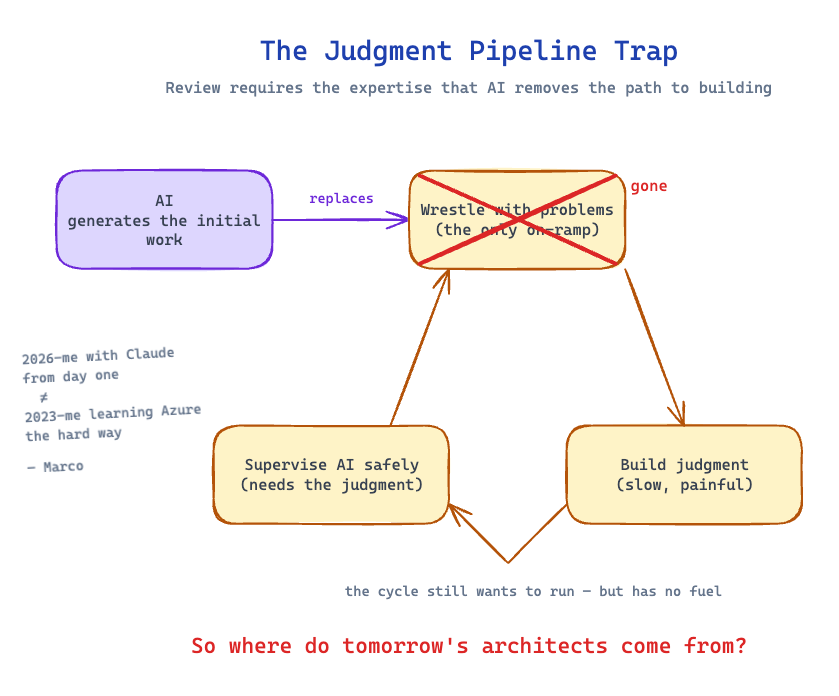
Reviewing AI output critically is harder than slowly writing the same output yourself. Juniors who skip the hard parts plateau early, and seniors lose the entry-level work that trained their successors. In Anthropic's January 2026 study, juniors who learned a new library with AI scored 50% on the comprehension quiz, the others 67%.
- A human owns every merged line. No bulk approvals of AI pull requests.
- Reviews that test understanding: "Walk me through why this works."
- No-AI exercises for juniors on debugging and reading unfamiliar code.
- Track churn and duplication per repo, and fail CI above a ceiling.
Days 60–90: measure and decide
12. Measure again against the baseline. The same four numbers and the same survey. Throughput without rework and review time tells you nothing.
13. Define fluency levels. Adapted from Zapier's levels and GitHub's adoption phases:
- Completion and chat.
- An agent in a set-up repo.
- Hands-off work through issues and automated runs.
- Builds setups for others.
A realistic target for the next quarter: every developer at level 2, every champion at level 4.
14. Decide on one page. Baseline, second measurement, cost per developer and year. Then roll out, adjust or stop, and say which.
From then on
- Every two weeks, 45 minutes: two demos, one problem.
- Every quarter, a half-day hackathon on a real backlog item.
- Every quarter: metrics to leadership, licences cleaned up, policy checked.
Two questions the plan doesn't answer for you
Pricing. If AI lets your people do two hours of work in one, billing by the hour halves your revenue for the same outcome, and competitors who use AI well will underbid you. Decide whether you bill by time, outcome, subscription or fixed price, and whether you track delivered output or only hours.
Debt you can't see. AI-generated debt has no author who remembers the shortcut. It spreads as duplication across repos instead of sitting in one legacy module, and the agent copies the patterns it finds, bad ones included. Linters measure the code, not whether anyone understands it. Pick a random file each quarter and ask someone to explain it end to end. Where nobody can, that's your debt map.
Pitfalls
- Licences first, plan later. Sooner or later someone asks what the licences brought, and you have no number to show.
- Trusting how fast it feels. In METR's early-2025 study, experienced developers were 19% slower with AI while believing they were 20% faster.
- The vendor dashboard as your only measurement. It counts usage. You need your own numbers from before the rollout.
- Champions without time. A title without hours is a volunteer job, and it ends with the first busy month.
- A mission without enablement, or the reverse. The first scares people, the second leaves them without a direction.
- One kickoff webinar. Monthly sessions and an afternoon next to a champion work; a single session doesn't.
FAQ
Should we ban ChatGPT and other consumer AI tools?
Block free consumer tiers on company devices and offer approved business tools instead. A ban without an alternative pushes the same data into private accounts.
How many champions do we need?
About 1 to 2% of the people you roll out to, at least one per team, each with 10 to 20% of their time signed off in writing.
What should we measure?
Four numbers before and after: the share of people using AI at least weekly, pull requests per developer and month, time to merge, and rework after review.
Can't we host our own model instead?
For AI applications that handle sensitive data, often yes. As the backbone for AI-assisted development, no: frontier models can't be self-hosted, and you'd get a model without the tooling around it.
Does the EU AI Act apply to a Swiss company?
The AI literacy duty in Article 4 applies since 2 February 2025 to anyone deploying AI in the EU, including Swiss firms serving EU clients. More in my post on the EU AI Act and the Swiss stance.
References
- Adoption at scale: McKinsey, State of AI · BCG, what drives AI value · MIT NANDA via Fortune · Gartner Copilot survey · a16z, a counterpoint
- Company examples: Shopify · Zapier · Allianz · UBS · Siemens · Swiss Post · ANZ Bank · Booking.com · Spotify · Duolingo · Commonwealth Bank
- Champions: TNW · Section AI
- Measuring: GitHub, driving Copilot adoption · GitHub, adoption cohorts · Jellyfish · Faros via ADTmag · DORA 2025 · DORA AI capabilities model
- Quality and skills: GitClear 2026 · METR 2025 · METR 2026 update · Anthropic, AI assistance and coding skills
- Shadow AI and security: LayerX via The Register · IBM, Cost of a Data Breach 2025
History
- 17 Oct 2026 New title and section headings that lead with the outcome; the URL stays.
- 16 Oct 2026 Rewritten for IT leaders as a 90-day plan, with the five patterns from ten companies that scaled AI tooling and a data traffic light. New URL; the old one redirects.
- 16 Oct 2026 Turned into a use case: the same arguments and checklists, reordered into a five-step path.
- 25 Sep 2026 Figures checked against the original sources, with newer data from DORA 2025, METR, GitClear and Anthropic.
- 19 Apr 2026 First version, as The Slippery Slope of AI Adoption: A Heavy User's Honest Take.
Roll out AI across your IT team in 90 days and measure if it pays
A 90-day plan to roll out AI tools in an IT organisation: one-line mission, data traffic light, baseline, champions with protected time, staged training and four numbers that show whether it pays. With what Shopify, Siemens, UBS and others did.
A GitHub repo where a coding agent opens pull requests and can't merge without you, plus a one-page sign-off sheet for whoever approves it.
Get the starter kit